SEO vs AEO vs GEO: The Future of Search is Expanding, and So Should Your Strategy
For two decades, "getting found online" meant one thing: ranking on Google. But search itself has splintered. Users no longer just type a query and scroll through ten blue links — they ask voice assistants for a quick answer, and increasingly, they ask ChatGPT, Gemini, or Perplexity to just tell them the answer outright, with no click required.
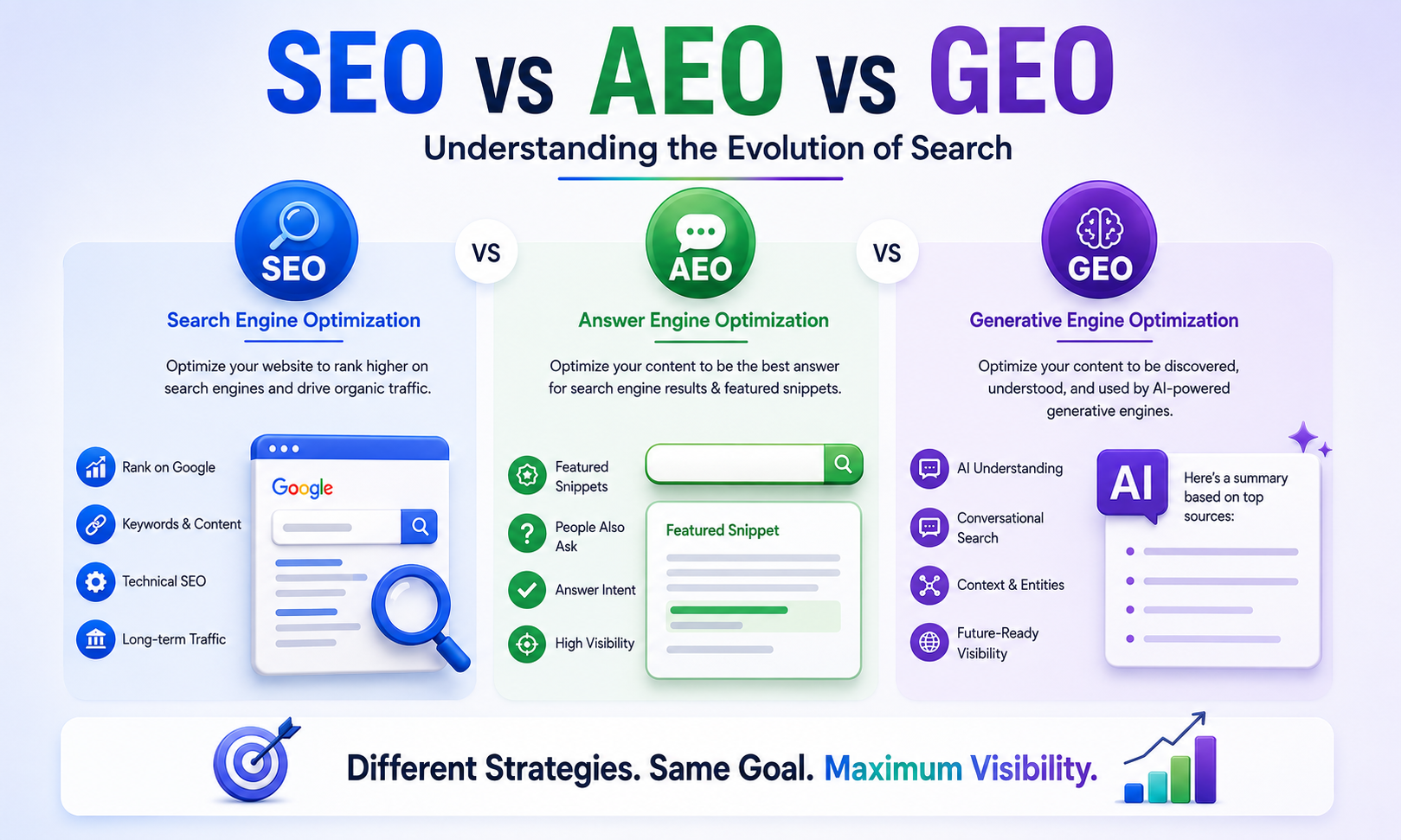
That shift has given rise to two new disciplines sitting alongside traditional SEO: AEO (Answer Engine Optimization) and GEO (Generative Engine Optimization). They're related, they overlap heavily, and none of them is replacing the others — but each targets a different part of how people now find information. Here's how they differ, and how to build a strategy that covers all three.
SEO: Ranking in the Search Engines You Already Know
SEO is the discipline everyone's familiar with: optimizing content and websites to rank higher on Google, Bing, and Yahoo. The goal is straightforward — show up on the search engine results page and earn a click.
Classic SEO focus areas haven't gone anywhere:
- Keyword research
- Technical SEO (site speed, crawlability, mobile-friendliness)
- On-page optimization (titles, headers, internal linking)
- Backlinks
- User experience
The content style tends to be long-form and keyword-rich, and success is measured in familiar terms: rankings, organic traffic, click-through rate, and bounce rate. This is still the foundation everything else builds on.
Also Read: SEO: Complete Guide for Beginners
AEO: Becoming the Answer
Answer Engine Optimization is about winning the moment when a search engine, voice assistant, or featured snippet tries to give the user one single best answer instead of a list of links — think Google's featured snippets, Siri, Alexa, or Google Assistant.
Where SEO aims for a high ranking, AEO aims to be the answer itself. That changes the optimization playbook:
- Structured data and schema markup (FAQPage, HowTo)
- Clear, concise, conversational answers
- Content phrased the way people actually ask questions out loud
- Strong E-E-A-T (Experience, Expertise, Authoritativeness, Trust) signals so the engine trusts your answer enough to feature it
Content here is short and direct — FAQs, definitions, step-by-step explainers — built to be lifted cleanly into a snippet or spoken back through a smart speaker.
GEO: Getting Cited Inside AI-Generated Answers
Generative Engine Optimization is the newest and fastest-moving of the three. It's about earning visibility and citations inside the AI-generated responses produced by tools like ChatGPT, Gemini, Perplexity, and Claude — platforms where users are given a synthesized answer, often without ever seeing a traditional results page.
GEO leans on:
- Original, experience-based content that can't just be paraphrased from what's already out there
- Strong topical authority across a subject, not just one high-ranking page
- Accurate, citable facts
- AI-friendly content structure
- Consistent brand mentions across the web
The outcome isn't a click, necessarily — it's inclusion. Your brand shows up, by name, inside someone else's conversation with an AI.
|
Aspect |
SEO |
AEO |
GEO |
|
Definition |
Optimizing content and sites to rank higher on traditional search engines like Google and Bing |
Optimizing for voice assistants and answer boxes that deliver one best answer (Siri, Alexa, Google Assistant) |
Optimizing content to appear in AI-powered platforms like ChatGPT, Gemini, and Perplexity |
|
Primary goal |
Visibility in blue links and organic clicks |
Become the single preferred answer for spoken or featured responses |
Earn visibility and citations inside AI-generated summaries |
|
Optimization focus |
Keywords, backlinks, on-page and technical SEO, UX |
Conversational phrasing, schema markup, FAQs, voice intent |
Data structure, factual accuracy, E-E-A-T signals, AI-friendly citations |
|
Content style |
Long-form, keyword-rich, SEO-structured |
Short, natural-language, direct responses |
Concise, factual, citable, multi-format |
|
Top ranking signal |
Authority (links, CTR, dwell time) |
Schema alignment and context clarity |
Credibility, freshness, structured markup, brand mentions |
|
Interface targeted |
Google/Bing search results |
Voice assistants and zero-click answer boxes |
AI assistants, chatbots, generative answer panels |
|
Key metrics |
Rankings, traffic, CTR, bounce rate |
Featured snippet share, voice query appearances |
AI citation frequency, visibility in AI responses |
|
Typical content formats |
Blogs, service pages, landing pages |
FAQs, schema data, concise explainers |
Q&A content, datasets, E-E-A-T-enhanced content |
|
Outcome |
Traffic growth and lead generation |
Greater brand recognition in voice and zero-click results |
Brand inclusion and visibility inside AI-generated answers |
Why This Isn't Really Three Separate Jobs
SEO, AEO, and GEO share many of the same optimization actions, which means there's real efficiency in the overlap between them. In practice, most of the work splits cleanly into two buckets, much like traditional SEO always has:
On-page: structuring content clearly, answering the specific questions your audience is asking, using schema markup, writing in plain and direct language, and backing claims with real data or first-hand experience.
Off-page: earning backlinks and brand mentions from credible sites, building a presence across review platforms and industry forums, and keeping your brand's name, description, and details consistent everywhere it appears online.
One useful step is auditing your keyword set to see which terms still offer a straightforward SEO opportunity because no AI overview appears for them, which ones are better suited to AEO, and which align with GEO — since not every query triggers an AI-generated answer in the first place. Service-based and local searches, like "plumber near me," still tend to surface local packs, ads, and traditional listings rather than AI summaries, simply because the user is looking for a provider, not an explanation. Broader informational queries — "how does compound interest work," "what is generative AI" — are far more likely to be answered directly by an AI Overview or a chatbot, often without a single click going to any website at all.
The Three Words That Matter Most: Experience, Expertise, Authoritativeness, Trustworthiness
Across all three disciplines, the hardest ground to hold — and therefore the most valuable — comes down to authority, experience, and trust.
Experience refers to the creator’s first-hand knowledge or practical experience with a topic. Content becomes more valuable when it includes real-world examples, personal experiences, original insights, case studies, or practical demonstrations rather than only general information.
Expertise means demonstrating sufficient knowledge and skills about a particular subject. Websites can show expertise through well-researched content, qualified authors, accurate information, expert contributions, and detailed explanations that provide genuine value to the target audience.
Authoritativeness refers to the reputation of the website, content creator, or organization within a particular industry. Strong authority can be demonstrated through quality backlinks, expert recognition, positive mentions, reputable sources, industry credentials, and consistently valuable content.
Trustworthiness is the most important aspect of E-E-A-T because users need to feel confident about the information and website. Clear authorship, accurate information, transparent contact details, secure websites, reliable sources, and honest claims can help improve trust.
Building a Strategy That Covers All Three
A workable approach looks less like three separate campaigns and more like one strategy with three lenses:
- Start with SEO fundamentals. A technically sound, well-structured site is the baseline every other layer depends on.
- Layer in AEO for high-intent, question-based queries. Structure key pages so the direct answer appears immediately, supported by schema markup.
- Invest in GEO where topical authority matters most. Go deep on the subjects your business is genuinely expert in, and make sure that expertise is reflected consistently across the web, not just on your own site.
- Track visibility differently. Traditional rank tracking won't show you whether you're being cited in an AI Overview or mentioned by ChatGPT. Periodically check how your brand shows up across these tools directly, and adjust based on what's winning those citations instead.
Search isn't becoming less important — it's becoming more distributed. The businesses that treat SEO, AEO, and GEO as one connected discipline, anchored in real authority, real experience, and real trust, are the ones that will stay visible no matter where — or how — people are searching.
Frequently Asked Questions (FAQs)
What is the difference between SEO, AEO, and GEO?
SEO focuses on improving rankings and organic traffic in traditional search engines. AEO focuses on providing direct answers in featured snippets, voice search, and answer engines. GEO focuses on getting your content, brand, or website mentioned and cited in AI-generated responses.
Is SEO still important with the rise of AI search?
Yes. SEO remains the foundation for online visibility because technical SEO, quality content, authority, and a strong website help support both traditional search and newer AI-driven search experiences.
How can I optimize my website for AEO?
Create concise answers to common user questions, use clear headings, implement relevant schema markup, write in natural conversational language, and demonstrate strong E-E-A-T signals.
How can I optimize content for GEO?
Focus on original and experience-based content, build topical authority, provide accurate and citable information, use clear content structures, and build consistent brand mentions across credible websites.
Does E-E-A-T matter for SEO, AEO, and GEO?
Yes. Experience, Expertise, Authoritativeness, and Trustworthiness are important across all three approaches. Original experience, accurate information, credible sources, expert authorship, and trustworthy brand signals can strengthen visibility.
Author Bio

www.busyblogies.com
Iftekhar is the founder of BusyBlogies, a content marketing strategy expert. He is a veteran of creating and managing digital content to build relationships for organizations and individuals. @iftekhar_ash